Showing posts with label books. Show all posts

Jun 4, 2009

Go greased lightning!

Or, perhaps not quite greased lightning. I somehow can't see John Travolta and his greasy crew getting very excited about our new people-mover. But I'm pretty excited. And off the top of my head, that song from Grease was the only car-pride anthem I could think of.

We are now the owners of a 1999 Toyota Estima Emina. Yep. We decided that a station wagon just wasn't going to be big enough for our growing family. (Well, not when relatives come to stay or we want to take a friend somewhere). As an aside, try saying "Toyota Emina" 5 times fast. Do you hear it? Worlds worst marketing decision.

But this post is not just about showing a photo of our new vehicle to our out of town relatives. It is also a book-review in praise of Auto Repair for Dummies, by Deanna Sclar.


Not that our car needed repairing at all - it survived the trip back from the Lakes District (where we bought it from) very well.

No, what I like about this book is that it starts with you as an absolute beginner (it explains, with diagrams, the difference between a standard and Philip's screwdriver, for instance), and walks you step by step through the whole shebang of car maintenance and repair.

I bought this book about 10 years ago when I got sick of suspecting I was being ripped off by my mechanic but having absolutely no idea whether I was or not. Being completely and utterly ignorant of the workings of my car meant that I couldn't tell the difference between a good mechanic and a bad one, or between a necessary repair and a waste of money.

With the help of this book I became quite proficient at the (very very) basic level of DIY car maintenance. Although I never got around to doing an actual oil change, I did replace the fuel and air filters and just generally took better care of my machine - making sure the tyres were properly inflated, being able to replace windscreen wipers, that sort of thing.

Once our first child came along and we replaced my old faithful hatchback with a sensible stationwagon I stopped doing the car repairs. For one thing, I was heavily pregnant at the time and just couldn't face getting down on my hands and knees in the garage. For another, the newer car had more stuff under the bonnet to get my head around - and everything just looked different. And once the baby was born I simply didn't have a couple of hours at a stretch to potter under the hood of the 'new' car to work out where everything was. So it just became easier to just rely on the mechanic again. We knew we had a good one, so that was alright.

When Merl drove our new beastie home, however, I was itching to get under the hood. You see, we bought this car via TradeMe (New Zealand's version of ebay), and didn't get it mechanically inspected or anything first (though we did get a VIR to check it was free from finance claims etc etc). I know. I know. Madness. But it was a very very good buy and even if it needs a couple of serious things done to it, we'll still be paying less than we would if we'd bought it through a dealer.

To set my mind at rest, I turned once again to my trusty Auto Repair for Dummies and performed the Monthly Under-the Hood Check. To see what I could see. Basically, all was more or less well, but there were a few things that I noted. Despite the car having been 'serviced' 2 weeks ago, the air filter was utterly filthy - so I can conclude that the 'service' was probably just an oil and filter change, and she's probably due a proper tune up. The hoses and wiring all looked in good nick, but the battery housing is quite corroded and the battery looks like it might even be leaking a little (despite it being new last year). So I think their mechanic was crap. The tyres were also horribly under-inflated - instead of being at 2.3kg per cm3 (approx 230kPa) - as specified on the little door decal, it looks like they were at 23 psi - not at all the same thing!

The one thing that completely stumped me was the search for the dipstick! I have no idea. I looked and looked and looked, and couldn't even see where I might add the oil itself, let alone find the dipstick. So if you know where to find such a thing on this model vehicle, I would be very grateful for the information!

By the end of yesterday, I'd inflated the tyres to their correct pressure, replaced the air filter and worked out how to use the CD changer (very important). I feel quite chuffed with myself. I'm sure it's driving better already, but she's still making the occasional funny noise. I'm now thinking that we might take it in for one of those 'pre-purchase inspections' just so we know what we're looking at. And then book her in for a full service and tune up, because I am, of course, heavily pregnant once more and am not going to do it myself.

One last word in praise of the Monthly Under the Hood Check-up. These things are really easy to do, and the very action of looking and seeing how your car is doing means you are far more likely to take her to a mechanic when something starts to go wrong, rather than waiting until it is very expensive and inconvenient.
  • Check the air filter
  • Poke all the belts to see if they're frayed or loose
  • Inspect the battery for corrosion/leaking
  • Check the levels of all the fluids - coolant, brake fluid, transmission fluid, windscreen washer fluid etc - in new cars these mostly have see-through reservoirs that you can just look at and see if its between 'max' and 'min' level
  • Squeeze the hoses to make sure they're neither spongy and bulgy nor brittle
  • Check the oil
  • Inspect the wiring to see if anything is loose
  • Check the windscreen wipers
  • Check the tyre pressure
  • ta daa!
Deanna Sclar of course gives detailed instructions on how to do each of these things (including how to open the bonnet of the car...), and although the first time I did it on my first car it took me a good hour, once I knew how to do everything it only took 15 minutes. Not a bad time investment when you consider that "taking care of these things can prevent 70% of the problems that can cause highway breakdowns".

All good.
Read more...

Apr 20, 2009

Family Treasures

Not my books - this picture is from somewhere in internet-land. But aren't they pretty?

I was examining the bookshelves at my Dad's house the other day, as is my habit, to see which books I wanted to rescue that day.

You see, although my Mum was a prolific reader and book hoarder, my Dad is not a reader. He has been known, now that Mum has passed away, to randomly sweep a shelf of books into some bags and donate them to a book sale.

Well okay, he only did it once. But in that shelf of books was a leather-bound copy of the Wind in the Willows, with beautiful colour plates, which Mum had been given as a child. I had quite deliberately left this book at Dad's house because I thought it would be safer there than on a shelf in my house, with the hands of small children reaching for it. Aaaaarrgghh.

I haven't quite articulated to him how devastating this was, but I did quietly request that the next time he gets an urge to purge books, could he call me first and I can go through them first? I didn't want to upset him, really, as there is nothing he can do about it anyway - and it is only a book, and I do have another copy of the Wind in the Willows (which is beside the point). And it was at least partly my fault for not telling him that I had left the book there on purpose - I had already removed plenty of books from his house, so he was reasonable in assuming that I had already taken anything I really wanted. But it being at least partly my fault just makes it worse, of course. Anyhow, he has promised not to get rid of any more books. phew.

However, I no longer see Dad's house as a safe place for books, so I rescue a bag or two each time we visit.

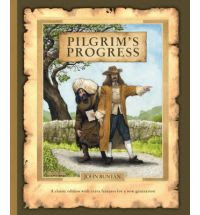
This last time, I spotted a copy of the Pilgrim's Progress. Which I confess I have never actually read, but which, like a lot of classics, is on my list of things to read 'one day'. So I picked it off the shelf and popped it into my bag (along with an encyclopaedic dictionary, a NZ pictorial history, some dictionaries of music, the Tell Me Why books...).
Book Depository picture - not my Great Grandma's copy

It turns out that this Pilgrim's Progress was a Miller's Flat Presbyterian Sunday School Prize awarded to my Great-Grandmother for achieving 52% in Scripture and 56% in Catechism in the Assembly's Exam, in December 1908.

How cool is that?!

I am very happy to have rescued this book - it even more than makes up for the Wind in the Willows, because this is the only thing I possess that was my Great-Grandmother's, whereas I have lots of stuff (too much stuff, to be honest) that belonged to my Mum. This is my Nana's mother, who died when Nana was only 13 years old. I can only imagine how much my Nana must have treasured this book.

The only thing I know about my Nana's mother is that she died young, and that my Nana believed that if she had lived my Nana would have been allowed to finish her schooling and perhaps even attend university. In the event, Nana (their only child) left school when her mother died, to keep house for her father.

But now I have her Sunday School prize of 1908, and I shall treasure it. It is a treasure not just for the book itself, though I'd have been happy to find any copy of The Pilgrim's Progress, and not simply because it is a link to one of my forebears about whom I know very little, but mostly it is a treasure for what it meant to my much loved Nana. This book was one of the few links she had to her own mother.

And now it is mine to treasure in turn.
Read more...

Sep 30, 2008

The Unschooling Handbook


While at the library last week I picked up a copy of "The Unschooling Handbook - how to use the whole world as your child's classroom" by Mary Griffiths.

If I wasn't already largely convinced of the practical common-sense nature of 'unschooling', this book would have done the trick. It answers all the common questions a parent might ask when thinking about this approach to their kids' education - including "what about maths?" (and science and reading and writing) and "how do you know if they're learning anything?"

I particularly liked the personal reflections from over a dozen homeschooling parents and kids that she has included. I found myself nodding while reading most of them (not all - if would be a strange world indeed if we agreed with everything everyone says :) ).

All in all, recommended if you even just want to know what on earth 'unschooling' means when it comes to the nitty gritty of what people do all day. Readable, chatty, informative and not remotely intimidating (doesn't use any "eduspeak" that I noticed). Read more...

Sep 27, 2008

Usborne Young Puzzle Books


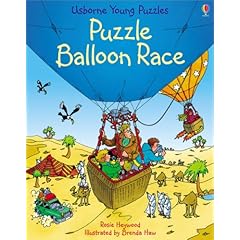
We borrowed the Puzzle Balloon Race from the library yesterday. This is the first time I've seen this series of books and they are right on target for where Miss4 is at. It's great to find something that she can read, and the puzzles are interesting but not too hard for her, but there are some that she can't do, so it stretches her too.

Not sure how long the interest will last once she's done all the figuring out there is to be done - so perhaps better as a library loan than a purchase, but I am very happy that we found them in the library. One thing she has never been great at is actually looking and finding stuff - not a strong visual learner at all - so it's great to have a combination of puzzles. Some are looking at the pictures and find certain things, but some are remembering what was read out earlier in the story, some maths puzzles (if each blast of hot air raises you 50feet, and you need to be 400ft higher than you are now, how many blasts of hot air do you need - we were flabbergasted when Miss4 replied correctly), some maze puzzles etc.

All in all, highly recommended for kids who can read, and like to do puzzly things but just aren't up to the Where's Wally or Animalia type books yet. Read more...

Sep 21, 2008

Affluenza - by Oliver James

I'm currently reading this book, by Oliver James. I am enjoying it immensely.

From the blurb...
There is currently an epidemic of “affluenza” throughout the world — an obsessive, envious keeping-up-with-the-Joneses mentality that has resulted in huge increases in depression and anxiety among millions. Over a nine-month period, author and psychologist Oliver James travelled around the world to try and find out why.
Basically the premise is that 'Selfish Capitalist' societies (of which America is the prime example - certainly in the way it portrays itself via the media etc), lead to a massive shift in the population's behaviour and values. The more 'selfish capitalist' the nation, the more likely its people are to neglect their needs in order to chase after their wants - without even being aware that that is what they are doing. James contends that this societal shift is what leads to those countries' very high rates of 'mental distress' (a term he prefers to mental illness - since it he believes it to be in many cases a normal response to an abnormal society/situation).

The needs he identifies are as follows,
We need to feel secure, emotionally and materially. We need to feel part of a community, to give and receive from family, neighbours and friends. We need to feel competent, autonomous and authentic, masters of our destinies to some degree.
And we trade those in so we can work for longer to get more money to buy more stuff, or work harder to get more qualified so other people will congratulate us or so we can finally be good enough for our parents/ourselves, or work harder so we can buy thinness or blondeness or other means of being sexually attractive (and therefore 'valuable'), or so we can get a bigger house, or a conservatory or a second house or a shinier car or whatever else we 'need' to have.

Sometimes we even kid ourselves that we can somehow achieve emotional and material security, or those other needs, by buying more stuff (true to a point - but untrue beyond basic subsistence levels), or being prettier (pretty according to whom? and of course there will always be someone prettier), or even that by working 8am to 8pm six days a week for someone else that we are somehow masters of our destinies and achieving autonomy.

He asserts that the long term effect of having those needs unmet, and of working harder and harder at misguided efforts to meet them, coupled with the pernicious continual mantra of advertising (what you have/are/do is not good enough - you need more), is mental distress - depression, anxiety, psychosis etc.

An interview with him, from about the time the book was published is here, and an extract from the book is here.

He also discusses the "vaccines" to the "virus" of affluenza that he observed in various places around the world. Some really thought-provoking observations.

The section of the book dealing with academic performance and 'virus values' rang very true for me - It's entitled "Educate your kids (don't brainwash them). It reminded me of an article I read a month or so ago, by Alfie Kohn, "How not to get into college".

Having suffered burnout myself after being a high achiever at school and in first year, I can attest to the pointlessness of sacrificing your health for better grades. I put enormous pressure on myself to succeed and had had no practice at 'failure'. Um, not getting into a highly competitive entry course, but still having an A- average counted as 'failure' for me - I really did not know how to handle this. I got a lot more practice in 2nd year (my first 'E'!).

I can actually remember very little of my second year at varsity. I recall looking through my 2nd year notes a year later while studying for my 3rd year exams and being astonished - I had absolutely no recollection of having written them, or even covering that material in lectures - I checked the name on the book and even got out other notes to compare the handwriting. They were mine. I think my body was attending the lectures (it certainly took good notes), but my mind was shut down.

Burnout, depression and the occassionally paranoid anxiety attack (anyone else crawled under their desk and just not wanted to get out ever?). All because my whole self-image was utterly pinned to getting into medical school - to being one of 'the top students' - to getting very high grades. Which are all comparative things - none of those had anything to do with my actual worth - it was my 'worth' compared to other people's. Not a recipe for good mental health. At some point I needed to let go of how other people viewed me, and stop measuring myself by the feedback I received from them, and build up my sense of self from the inside out. That was an extremely hard process - one I'm not sure I've finished yet.

That's one of the things Oliver James gives as a 'vaccine' to the afluenza 'virus' - being 'intrinsically motivated' is vitally important. Even people with 'virus goals' (e.g. top promotion) are generally protected from mental distress if their motivations are intrinsic rather than external (e.g really enjoying your job for its own sake).

I'm about 2/3rds of the way through the book and I recommend it so far. Even if you disagree with him it provides some interesting food for thought. Read more...

Jun 1, 2008

Review - Living More With Less


by Doris Janzen Longacre.

I picked this book up at the Regent book sale last week, and am finding lots of good stuff in it. I had previously heard good things of the More With Less Cookbook, so didn't hesitate to pop this title in my bag.

The sub-title (if that's the correct term) is "a pattern for living with less and a wealth of practical suggestions from the worldwide experiences of Mennonites."

The book lists five principles for Living More with Less. Here is my brief re-writing of what I picked out of each of those 5 chapters:

1. Do Justice. Be aware of the link between our wealth and the poverty of others, and act to change that situation as you are able

2. Learn from the World Community. Those who are forced to live with less inevitably have lots of things to teach us about doing so. This wisdom will also extend into other areas. The West deludes itself when we think that we are always the benefactors and the 'third world' are the grateful recipients of our patronising aid. It is good to be humble and listen to what others might be able to tell us about life the universe and everything.

3. Nurture People. People are, by definition, not 'things.' The more effort we put into our 'things,' the less energy and time we have for people. And vice versa.

4. Cherish the Natural Order. God made the planet to work the way that nature works. If we correctly understand our role in this world, we will work with God's natural order. Nature is not the enemy to be subdued by our big machines, rather "God saw what He had made and it was good." (Genesis 1)

5. Nonconform Freely. Striking the balance between 'freedom' and 'obligation' is never easy. Tread lightly, be aware of how your choices affect those around you (especially your children, for whom your free choices might feel like a shackle to overthrow), try and make your decisions for good reasons, not just because that's the new accepted rule. Find kindred spirits for mutual support and encouragement.

What follows those brief 5 chapters is page after page of testimonial-type hints from hundreds of people making small and large choices to live more simply. Lots of very practical ideas ranging from "darn your socks," and "eat less meat," to "have a significantly smaller house," "limit your budget to what your family would receive on welfare and donate the rest," and all sorts of other things.

The book is also sprinkled through with relevant quotes from scripture, literature, poetry, proverbs from various countries etc. I'll leave you with one:

Lord, I know not why I eat
And millions die of hunger.
What doth it profit thee to give me food?
What give I in return?
Crumbs, just crumbs.
Lord, here is thy bread.
- M. T. Brackbill, from "Bread for Bread"
published in Gospel Herald
Read more...

May 16, 2008

Sprout Bread, and review of Sproutman's Kitchen Garden


Sprout Bread a la Sproutman

Well, we baked it and ate it. Verdict: edible, unusual, tasty, but probably not going back for seconds.

The basic recipe is to take 2 cups of whole wheat berries, sprout them the same way you'd make your own mung bean sprouts or whatever, but when the shoot is not quite as long as the length of the berry, puree them to a paste in the food processor. Then shape it into little roll-sized loaves and 'bake' at 125degC for about 3 or 4 hours.

The flavour is quite sweet and malty, because when the wheat berries sprout their enzymes all kick into action and produce a fair amount of maltose. So that's quite yummy. And the sprouts are way more nutritious than straight wheat flour. I think the flavour would go better in a biscuit (what the North Americans would call a cookie). There are recipes for such in the cookbook, and I'll try them next. Just think, cookies with no sugar, no wheat flour, no baking soda etc etc. Good stuff.

It's funny, but despite the Sproutman being a near Vegan, there is a whole lot of cross-over between the recipes in his "Kitchen Garden" book and those in Sally Fallon's "Nourishing Traditions" book (fan review here), who is a confirmed meat-o-saurus, and whose book we now own because I thought it was so good. The cross-over comes because both authors/food philosophers believe strongly in reducing the 'processing' of food to almost nil, in maximising the enzyme content of your food, and have a strong emphasis on lacto-fermentation. Most of the recipes in the Kitchen Garden book would not be at all out of place in the Nourishing Traditions book.

All in all, I recommend the book, but not, perhaps the bread :) Read more...

May 2, 2008

What Katy Didn't Do

I have just re-read What Katy Did by Susan Coolidge to check whether it might do as our next read-aloud chapter book. I'm on the hunt for good books, which contain nothing scary (Miss4 has a very vivid imagination), which don't condescend to kids, and have enough happening in them to engage her. Verdict on 'What Katy Did': not yet, probably better for them to read themselves when they're about 8 or 10.

But I was forcibly struck by one incident in the "Katy at School" part of the story. Katy is nearly expelled and is very definitely punished (unjustly), for 'unladylike conduct'. A note had been passed from one of the girls in the boarding school to a male student at the next-door college, signed "Miss Carr". This action of passing the note to a boy was considered to be wantonly forward and disgraceful conduct.

What struck me was the contrast between this standard of moral behaviour in 1860s America, and the expectations of our own society for teenage girls. Back then, merely communicating with a boy without your family's knowledge and permission was considered brazen and wanton - a reason to be sent home in utter disgrace. Today, if you are still a virgin at 18 you are considered hopelessly prudish, unattractive and uncool.

While I do not wish to return to the limited life choices that women had in those days, or any of the other social evils of the day (slavery, indentured servitude, a rigid class system of 'Society', arranged marriages) , there was a baby in with that bathwater.

In looking around at the dolls, clothes, greeting cards and magasines targeted at "tweens" (8-10year olds), it seems that the marketers and whomever else is driving pop-culture, is telling our 8 year olds, that in order to be a success you must dress and act like a whore, boys must like you "that way", and you will have ''romance" in your life. Excuse me? Since when has playing the market been the key to happiness? Since when have pre-teens (or even teens) been mentally and socially capable of the whole dating mine-field? (I know grown-ups reduced to tears at the thought of being back in the market - why are we putting that sort of stress on children?)

In this supposed age of feminism and choice for women and exaltation of all things female, there is a total absence of reverence for the Maiden phase of the cycle. How much more freeing it might have been to be a teenager in the days when you were not expected to be mate-hunting throughout your adolescence. How much energy could we have poured into other things? Read more...

Apr 14, 2008

Book Review - The Complete Book of Massage

The Complete Book of Massage, by Clare Maxwell-Hudson

Merl bought me this book for my birthday a couple of years ago. Excellent choice. Usually with massage books you need to put up with a lot of tantric stuff or Indian mystic stuff. Or in order to get a good overview of whole-body relaxation massage you are looking at a book the size of the phone-directory. Not this one.

This book is about the size of a large magazine - easy to refer to when you have oily hands. It also has heaps of illustrations and shows each part of the body with a whole sequence of different strokes for relaxing it. There's also an excellent little 10 minute massage suggestion for the back/shoulders, which has come in very handy for us. On top of this, there are sections on baby massage and pregnancy massage, as well as a good general section on anatomy and a very good general introduction to the different types of stroke and, very importantly, when not to give someone a massage.

All in all, highly recommended. Read more...

Apr 12, 2008

Raiding the bookshelves

The girls and I spent the day around at Dad's house today, while Merl was at a children's ministry workshop. Aside from having a lovely day in the sun and eating his good food and just generally hanging out, I raided one of the bookshelves and brought home 2 supermarket bags full of books.

This is an ongoing project. My Mum was a big reader, but Dad is not. Dad is wanting to quietly remove most of the books from the house - part of his dealing with his grief. I, on the other hand, see many of these books as being an essential link with my Mum. Also, there are (or were until today) a bunch of my childhood books still there that I do not want to inadvertently end up at someone else's house.

Today's books included the following - all excellent books for kids about age 10 up

Little Women series, My favourite childhood 'girly' books (Anne of Green Gables came a close second)
Tanglewood Tales, A collection of retellings of Greek and Roman classical tales
Robinson Crusoe, Adventure story, good food for the imagination
The Coral Island, ditto
The Halfmen of O and The Priests of Ferris, classic young adult Fantasy by NZ author Maurice Gee.
The Small Woman, a Biography of Gladys Aylward, Missionary to China during the mid 20th Century
I, Elizabeth Tudor, by Arthur Groom. Biography of Elizabeth I (part of a 'junior historical fiction' series)
The Jungle Books, by Rudyard Kipling

I have very fond memories of all of these books (except Robinson Crusoe, which I suspect I have actually never read), and am looking forward to reading them again. I hope the girls will want to read them in time too - but even if they have no interest, I am happy to have them back in my house :) Read more...

Apr 5, 2008

Book Review - White Owl, Barn Owl


We got this book out from our library last week. Miss4 loves it. The illustrations are magical, and the gentle story of a Grandpa building a nesting box for barn owls then taking his granddaughter out in the evenings to quietly see if a barn owl appears is just lovely. "We were patient lots of times!" reads the text - just what I can imagine Miss4 saying.

The story is surrounded by good barn owl information - how they hunt, where they nest, what they eat, why and how they are so silent when they fly... A great 'living book' of natural history for picture-book aged readers.

At the end of the book are instructions for making a couple of types of nesting box, so you can help provide shelter for these increasingly endangered beautiful birds. They have a widespread distribution on Earth, but are endangered in some areas (like the Midwestern US) due to habitat destruction. More barn owl info here

Now I wish Barn Owls lived in NZ so we could build a nesting box!
. Read more...

Mar 24, 2008

Quotes from Charlotte Mason's Home Education

5th Edition, published 1906
By Education is Atmosphere it is not meant that a child should be isolated in what may be called a 'child environment' especially adapted and prepared; but that we should take into account the educational value of his natural home atmosphere, both as regards persons and things, and should let him live freely among his proper conditions. It stultifies a child to bring down to his world to the 'child's' level...

The mind feeds on ideas, and therefore children should have a generous curriculum.
In my previous Charlotte Mason post, I said that she'd been out of print for about a hundred years, but I have since learned that this is not the case. They were republished in the States in 1989 as "The Original Homeschooling Series" by Charlotte Mason, and are still in print. I'm enjoying it very much. I've just started reading the first volume, and she's very readable.

Also came across another quote today which I'll share;
To be Queen Elizabeth within a definite area, deciding sales, banquets, labors and holidays; to be Whiteley within a certain area, providing toys, boots, sheets cakes. and books, to be Aristotle within a certain area, teaching morals, manners, theology, and hygiene; I can understand how this might exhaust the mind, but I cannot imagine how it could narrow it. How can it be a large career to tell other people's children about the Rule of Three, and a small career to tell one's own children about the universe? How can it be broad to be the same thing to everyone, and narrow to be everything to someone? No; a woman's function is laborious, but because it is gigantic, not because it is minute.

G.K Chesterton, The Emancipation of Domesticity

Read more...

Mar 15, 2008

Fav quotes from "Real-Life Homeschooling"

From "Real-Life Homeschooling - The stories of 21 families who teach their children at home", by Rhonda Barfield.

This is a quote from Kristin (age 23), the eldest of 3 kids whose family home educates because it fits best with their lifestyle and their ideas of what being human all about. They have no formal religious or faith structures, and practice 'unschooling'. Kristin no longer lives at home, but works as a Zookeeper, and is responsible not only for animals but for other staff, as well as the supervision and training of volunteers.
"I went to public school up until fourth grade," she says. "Fifth through eighth, I was homeschooled, then decided I wanted to go back to high school to be a 'big girl.' I quickly realised that was the wrong decision, but in the long run it has given me a good perspective on homeschool versus traditional school." Kristin thinks that school forces children to choose between conforming to the norm, acting like a bully, or being shy. "By the time they are ready to make friends outside the family unit, in the neighborhood, or through other activities, homeschool children are already comfortable with being themselves," she says. "At home, a close family like ours knows who you are and loves you anyway. That builds a strong base of confidence, which makes it easier to say no to the things you don't want to do and yes to the things you do."
And another piece which really struck me was the 'best advice' and 'worst advice' opinion of Lynda, a woman who has Wiyot Indian ancestry (who herself insisted that she preferred 'Indian' to 'Native American') and homeschools one of her sons, some of her grandchildren and a foster son who spends time with them as the need arises.
Best advice: "Believe because you do know," from Lynda's grandfather. "Follow what you think you know because you really do know it. Go with your gut feeling."

Worst advice: 'They' - the doctors, the schools, the politicians - know best
Read more...

Feb 2, 2008

birthday photos


Miss1's birthday was last Monday and the week has gone by so fast I haven't gotten around to posting photos yet. So here they are - just a couple. I'll get some more from my Dad and my Aunt. Hopefully somebody remembered to take a photo with Miss1 and the cake - I completely forgot!

In other news, I found this great site for all about cloth nappies - Boise Cloth Diapers. It's got a great list of all the options, the pros and cons of different fabrics, how to look after the different types of covers, and most usefully, a good troubleshooting page with tips on what to do if your waterproof covers aren't waterproof anymore - which has been a problem in our house! The answer is to get some waterproofing stuff from an outdoors store. (well why didn't I think of that!) So I compromised and used some Dubbin - hopefully it will work as well on PUL as it does on leather! Thanks to Planet Green for the tip.

Am also immoderately pleased to have found the 12th Matthew Bartholomew mystery at the library. Medieval Mystery novels are a weakness of mine. So I will be neglecting my home and children for the next day or so until the mystery is resolved. Fortunately Merl and Miss3 are off to a birthday party this afternoon so that gives me a couple of hours for reading right there!

Oh I miss lying in bed on Saturday mornings and reading for hours and only getting up when I was too hungry to stay in bed. Unspeakable luxury! Read more...

Dec 6, 2007

your money or your life

Brilliant brilliant book.

I cannot emphasise enough how good this book was for helping us put money and work into the proper perspective.

Your Money or Your Life - by Joe Dominguez and Vicki Robin Read more...

Dec 1, 2007

kids book recommendation


We like Ella the Elegant Elephant. She's cute and funny and nice and learns neat little life lessons. But the coolest things are the illustrations - like Babar the Elephant and Madeline and Curious George all rolled into one. Timeless elegance. The Ella books are great. Read more...

Sep 23, 2007

Book review - Kage Baker's Company novels

I was delighted to see Kage Baker's 6th Company novel "The Children of the Company" when we were in at the library yesterday. I love this series. Whenever I see a new one at the library I snaffle it up immediately. They're a deceptively easy read. You get sucked lightly into the most complex plots and it stays in my mind for days afterwards as I work through the implications of what happened in this book in the context of the whole story.

The main over-arching plot is a science fiction cross with historical fiction and adventure/suspense. The Company exists in the 24th Century and has unlocked the keys to time travel and immortality. Sadly, time travel is hideously expensive and painful, and immortality (in the form of being converted into a cyborg) is the same - and can only be done on small children of the right physical type. No good for aging millionaires. So The Company decides to make its money by planting cyborgs in the ancient past and plundering treasures from past civilisations. "In the Garden of Iden", the first company novel, is a captivating read - mostly set in 16th Century England. As the series progresses the role of The Company gets more sinister and more complex as you find out more about what different 'immortal operatives' understand about their role and the history of The Company.

I'm sure I'm not doing it any justice at all, but it really is exceptional. If you at all enjoy historical fiction, mystery novels, suspense or any science fiction at all you will like these books. Read more...
Older Posts Home